
Toilet Meditation: 6 Stages to Teach Your Patients
By: Shelly Prosko, PT, CPI, C-IAYT; Editor: Nataliya Zlotnikov, MSc, HBSc ∙ Estimated reading time: 4 minutes
By: Shelly Prosko, PT, CPI, C-IAYT; Editor: Nataliya Zlotnikov, MSc, HBSc ∙ Estimated reading time: 4 minutes
Can You Meditate While Pooping?
Mindfulness practices are gaining popularity and even appear trendy these days.
Perhaps it is because we know, and have experienced, that there is tremendous value in being present and mindful throughout our day.
We talk about mindfulness during many activities such as driving, walking, exercising, eating, socializing, etc.; so why not also be mindful while going to the bathroom?
Yes, mindful pooping!

Meditation for Bowel Movement
Being fully present and aware of our bodies, minds and emotions can help release the pelvic floor muscles when we perform our toilet duties, resulting in successfully completing our task.
We oftentimes are in a hurry and rushing with the attitude of ‘hurry up and just get it over with, I have something important waiting’ or our minds are elsewhere as we are texting or reading, which can be distracting from our present intention of the moment: to empty and eliminate!
This could lead to not fully relaxing and releasing the pelvic floor muscles, or not fully emptying the bowel or bladder, which may potentially contribute to or exacerbate a variety of pelvic health issues like:
- Urinary urgency
- Frequency
- Incontinence
- Constipation
- Pelvic pain conditions
I have a short 'Toilet Meditation' that I like to share with my clients/students that involves 6 stages, using the acronym “AIRBAG” to help you remember (more on this below).
Shelly Prosko's 7-minute Toilet Meditation
This above meditation is also part of Shelly's online healthcare course, PhysioYoga and the Pelvic Floor.
Explore PhysioYoga & the Pelvic Floor
Toilet Meditation Using AIRBAG Acronym
If you are sitting on the toilet, it’s a good idea to place your feet up on some blocks so that your knees are slightly higher than your hips.
This is an ideal position for your pelvic floor muscles to be released and allows for proper elimination, particularly for bowel movements.
If you are standing during urination, these toilet meditation stages of “AIRBAG” can still be performed.

The more refined your awareness skills are, the more you can trust what feels right, and not always what you think you should do.
The AIRBAG Method: 6 Stages of Toilet Meditation
What follows is a lovely explanation of the AIRBAG acronym that you can learn and share with your clients.
Awareness (A)
A brief body scan from head to toe, simply observing sensations that you may be experiencing both externally and internally, without judgment. You may include awareness of thoughts and emotions, without elaborating on a story or analyzing.
Imagination (I)
Use your visualization skills to imagine your pelvic floor and the general area where the pelvic floor muscles are located: they expand across the inside of the front, sides and back of the pelvis, the tailbone and the sacrum. Visualize where the bladder and bowel are positioned and imagine them emptying and that the pelvic floor muscles spanning across the pelvic floor are healthy and functioning optimally.
Release & Relax (R)
Let go of any tension in the pelvic floor muscles as best as you can. Releasing and relaxing these muscles can sometimes be difficult for a variety of reasons. Letting go may take courage, trust, concentration and practice.
Breathe (B)
Allow your natural breath pattern to emerge.
As you quietly inhale, the belly will naturally go ‘out’ and the pelvic floor will descend. As you exhale, the belly and pelvic floor muscles will return to their resting positions. During your pooping meditation, see if you can simply allow the quiet rhythm of the abdominopelvic diaphragmatic breath to happen on its own without trying to change it.
Allow (A)
This ‘allowing’ is a little more than just releasing and relaxing or allowing the breath to happen on its own. See if you can really give yourself permission to trust that your body knows what to do and when to do it.
Perhaps you feel the need to ‘push’ gently (do not strain) or you feel like you want to take a deep breath or lean forward or place your feet in a different position.
Gratitude (G)
I think it is a healthy practice to not only be completely present and mindful when toileting but also to honour this sophisticated and truly complex function that our body does for us daily without us even asking it to.
So each time you complete your toileting event and bathroom meditation, see what it feels like to send a little gratitude to your body and all its incredibly phenomenal parts to end your meditation!!
Sometimes when we ‘try’ to breathe, we create more tension that results in unnatural patterns that don’t serve a relaxed state.
Bringing Toilet Meditation Into Your Practice
Toilet meditation works best when clients can already sense, breathe with, and release their pelvic floor. Embodia's home exercise and patient education libraries can help you build those skills between sessions. They draw on resources from Shelly and a range of other instructors and clinicians, as well as the Embodia Team.
Pelvic Floor Awareness & Relaxation Resources (Embodia HEP):
-
Awareness: Side-Lying Palpation (Shelly Prosko)
-
Awareness: Seated Tactile Feedback (Shelly Prosko)
-
Awareness: Child’s Pose (Shelly Prosko)
-
Symmetry Routine (Embodia Team)
-
Pelvic Floor Relaxation with Ball Support (Brooke Winder)
- Pelvic Floor Relaxation in Tail Up Position (Brooke Winder)
Condition-Specific Patient Education Resources:
-
Overactive Pelvic Floor Muscles (Embodia Team)
-
Diaphragmatic Breathing - 7 Breathing Tips to “Quiet” Your Pelvic Floor (Embodia Team)
-
14 Constipation Tips - Tips to help improve how, when, and what you poop! (Embodia Team)
-
Evacuating the Bowels (Pelvic Health Solutions)
-
Patient Instruction for Complete Evacuation (Pelvic Health Solutions)
-
Exercises For Releasing Tension in The Pelvic Floor (Pelvic Health Solutions)
-
Airbags and Potty Talk (Carolyn Vandyken)
Embodia's patient education library also includes resource collections to help clients understand their bowel, bladder, and nervous system. Browse Carolyn Vandyken and Renee Quiring's Bowel & Gut Health Patient Education and Carolyn's Whole-Person Pelvic Health Patient Education collection.
Here's an example of one of the pieces available in Embodia's patient education library:
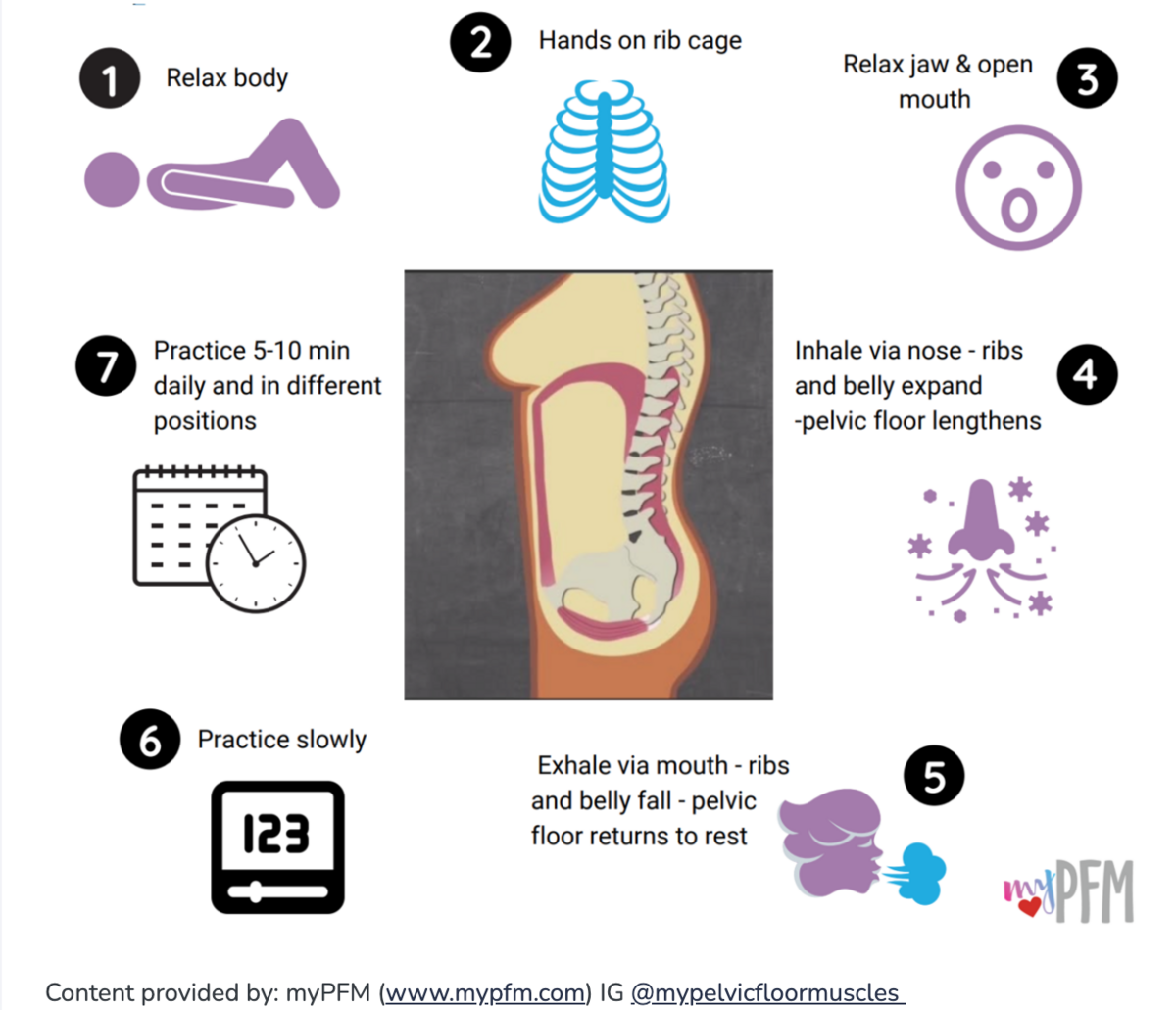
Diaphragmatic Breathing - 7 Breathing Tips to “Quiet” Your Pelvic Floor (Embodia Team)
How to Share Through Embodia
Embodia's Home Exercise Program (HEP) feature allows clinicians to prescribe exercises and share patient education from the same platform. Education can be added alongside an exercise program or shared as standalone content- useful for sessions where you want to seed a concept before diving into it at the next appointment.
Sharing education takes a few clicks: find the resource in the patient education library, click Share, and optionally add a personalized note for your patient. Your patient receives it directly through the Embodia app or web platform, where they can read it at their own pace between sessions.
This guide, Sharing education, walks you through sharing patient education step by step.
Explore Shelly's Online Course
PhysioYoga & The Pelvic Floor
What Does this Course Offer
What will you learn in Shelly's online healthcare course, PhysioYoga and the Pelvic Floor?
Honestly, quite a lot.
Too much to put into this blog. So if you are curious, check out the course page by clicking on the yellow button above.
In brief, though, this course intends to offer a theoretical and experiential integration of accessible and practical yoga methods and philosophy with evidence-informed practices to enhance overall pelvic floor health and wellness.
The Course is Intended for:
Rehabilitation professionals and movement specialists including but not limited to:
- Physiotherapists
- Physiotherapy assistants
- Occupational therapists
- Occupational therapy assistants
- Athletic therapists
- Exercise therapists
- Kinesiologists
- Yoga teachers
- Yoga therapists
- Movement specialists who are interested in learning more about yoga and pelvic floor health and wellness
If you'd like to learn more, take a look at Shelly Prosko's course, PhysioYoga and the Pelvic Floor!
Happy Toileting!
---
Date written: 30 Sept 2019
Last update: 5 Nov 2026

PT, C-IAYT, PCAYT
Shelly has been helping people recover and flourish since 1998 as a physiotherapist, yoga therapist, educator, author and pioneer of PhysioYoga, blending evidence-informed body-mind-breath-spirit-heart centered practices and principles, such as yoga, into physiotherapy with a focus on chronic pain, pelvic health, compassion in healthcare and professional burnout. She is on faculty at several therapy programs, presents at medical conferences globally, contributes to academic research and writing, provides classes, courses and resources for the general population, and offers continuing education courses and mentorship for professionals.
She considers herself a lifelong student and emphasizes the immense value gained from clinical experience and learning from those she serves, the professionals she teaches, and the colleagues with which she collaborates.
Shelly is the co-editor/author of the book Yoga and Science in Pain Care: Treating the Person in Pain and has authored numerous book chapters in a variety of rehabilitation textbooks.
She maintains a clinical practice in Sylvan Lake, Alberta and believes compassion (including self-compassion), meaningful connections, spending time in nature and sharing joy are powerful contributors to rehab and well-being.
Visit www.PhysioYoga.ca to learn more.