
Vestibular Exercises: A Clinical Reference for Practitioners
By: Embodia Team ∙ Estimated reading time: 10 minutes
By: Embodia Team ∙ Estimated reading time: 10 minutes
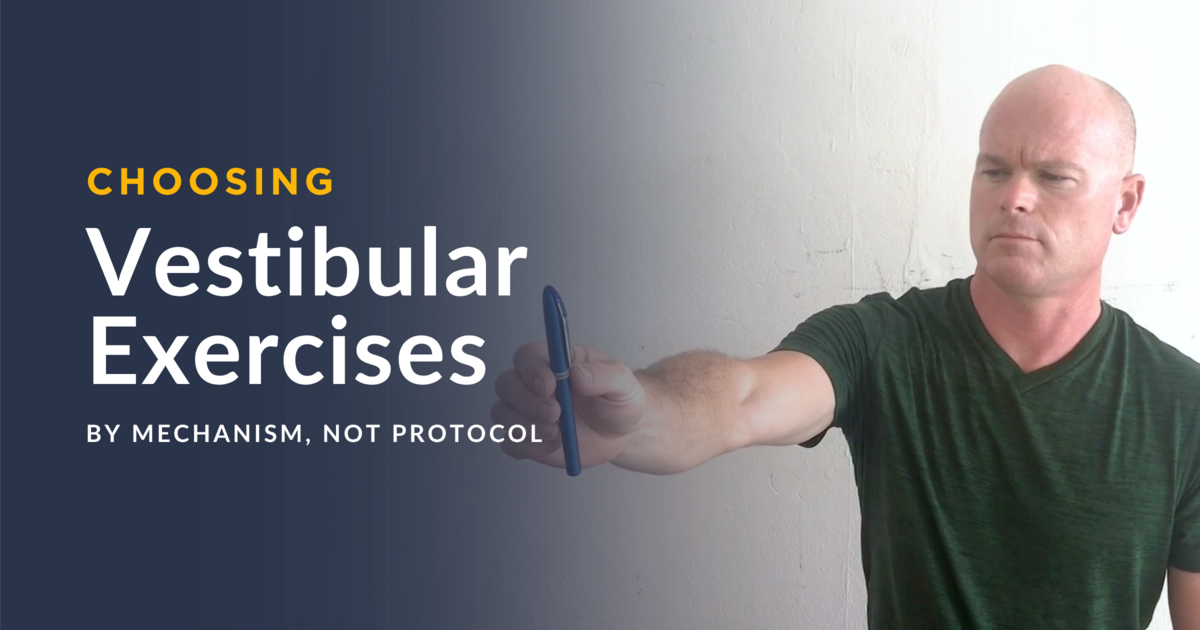
What Are Vestibular Exercises?
Vestibular exercises are targeted movements that retrain how the brain integrates inner ear, visual, and proprioceptive signals to control balance and eye movement. The vestibular apparatus, semicircular canals (rotational movement) and otolith organs (linear motion and gravity), feeds positional data to the brain that underlies postural control.
Vestibular rehabilitation is indicated for:
- Unilateral and bilateral vestibular hypofunction
- Benign paroxysmal positional vertigo (BPPV)
- Vestibular neuritis
- Ménière's disease
- Vestibular migraine
- Post-concussion dizziness and balance impairment
Three mechanisms drive recovery:
| Mechanism | Clinical application |
| Adaptation | Gaze stabilization drills recalibrate VOR gain and timing |
| Habituation | Repeated exposure to a provoking movement reduces symptom intensity over time |
| Substitution / compensation | Increased reliance on visual and proprioceptive input when vestibular function is reduced |
CRPs (e.g., the Epley maneuver) work mechanically rather than through neural adaptation. They reposition displaced otoconia rather than retrain the CNS.
Exercise selection depends entirely on an accurate differential, and dizziness is one of the harder presentations to sort quickly. Sonia Vovan's Dizzy Brain Approach works through a structured framework for reaching a working differential within the first five minutes of assessment.
Safety and Program Setup
Confirm a full evaluation has ruled out red-flag pathology before starting a program. Refer for urgent medical assessment if a patient presents with sudden severe headache, slurred speech, unilateral weakness, double vision, chest pain, acute unilateral hearing loss, or facial drooping. These may signal a central or cardiovascular cause requiring workup first.
For patients presenting with acute vestibular syndrome specifically — continuous vertigo lasting more than 24 hours with nausea, spontaneous nystagmus, and gait unsteadiness — the HINTS+ exam is the bedside tool for separating peripheral causes from posterior circulation stroke. Kregg Ochitwa's HINTS+ Exam Demystified breaks down each component with clinical video and covers the red flags that mandate imaging regardless of exam findings.
Setup Guidance to Give Patients
When prescribing a home program, a few common instructions to provide to patients are:
- Clear, well-lit space near stable support (counter, sturdy chair, wall)
- Supervision on hand for patients with significant imbalance or a fall history
- Non-slip footwear; trip hazards removed
- A 0–10 symptom scale (dizziness, nausea, imbalance) tracked before/during/after sessions to guide progression
Embodia can deliver written and video safety instructions alongside each prescribed exercise.
Cawthorne-Cooksey Exercises
One of the earliest structured VRT protocols (1940s), still integrated into modern practice for labyrinthitis and other inner ear injuries. Exercises progress by position lying/sitting, standing, walking; moving from isolated eye movements to combined eye-head-body tasks that desensitize the vestibular system and improve gaze/postural coordination.
Representative progression:
- Sitting/lying: eye movements (vertical, horizontal, diagonal) with the head still; head turns; head nodding — 5–10 reps, 2–3x/day early in rehab
- Sitting, combined: eye tracking on a target while turning the head; shoulder mobility; reach-and-retrieve tasks — up to 10 reps
- Standing: sit-to-stand, head turns while standing, overhead/diagonal reaching, ball toss at eye level, weight shifts; progress to tandem or feet-together stance as tolerated
- Walking: head turns while walking, surface progression (flat → ramps/curbs), stair training, dynamic ball/object tasks
Tier 2 and 3 Members can prescribe this progression directly from Embodia's vestibular exercise library, which includes standing Romberg with eyes open and closed, tandem stance and tandem walking (forwards and backwards), forward and backward walking with head turns and head nods, standing and walking ball toss, and weight shift drills — each with patient-facing video and a print-friendly version.
Here's an example of one of many Cawthorne-Cooksey exercises available on Embodia:
Gaze Stabilization (VOR Training)
Trains the vestibulo-ocular reflex to keep vision clear during head movement.
- VOR x1: fixate on a target at eye level while turning the head side to side or up/down
- VOR x2: target and head move in opposite directions. Progress only once VOR x1 is well tolerated
Progress across five levels: sitting/plain background → standing/plain background → standing/busy background → walking in open space → walking in a busy environment. Sessions of 30–60 seconds, several times daily, with speed adjusted so the target stays just short of blurring.
The exercise library also covers the oculomotor work that often runs alongside VOR training, including: horizontal, vertical, and diagonal saccades (in sitting, standing, and walking), horizontal and vertical eye tracking, alphabet eye tracking, pencil push-ups, Brock string, blind spot checks, and eye stretches. All assignable with practitioner-specified duration, frequency, and background complexity.
Here's an example of one of many VOR training exercises available on Embodia:
Canalith Repositioning for BPPV
BPPV produces brief, intense positional vertigo from displaced otoconia in a semicircular canal. CRPs — Epley (posterior canal), Semont, and the barbecue roll (horizontal canal) — mechanically guide the crystals back to the utricle.
Clinical note: Initial diagnosis and first-treatment maneuvers must be performed by a trained practitioner who can identify the affected ear and canal; unsupervised attempts without proper diagnosis can worsen symptoms or fail outright. Home CRP protocols can follow once a patient has been taught the correct technique in-clinic.
Expect brief but potentially intense vertigo during the maneuver, possible residual unsteadiness for 24–48 hours, and typically 1–3 treatment sessions to resolution.
For practitioners who want the full BPPV toolkit in one place, Cheryl Wylie's BPPV Resource Package adds every test and treatment video to your exercise library: Dix-Hallpike, head roll and side-lying tests, Epley, Semont, Gufoni, Casani, and BBQ roll for both left and right. A practitioner assessment and treatment flow chart, prescribing templates by canal and pathology type, and a patient education handout are also included.
Embodia's library also includes patient-facing self-treatment guides from Kregg Ochitwa covering the self-modified Epley (left and right), self BBQ roll (traditional and revised, both ears), the Brandt-Daroff maneuver, and optional post-treatment activity restrictions.
Where BPPV presents alongside concussion, Annie Howard's Vertigo and Concussion Resource Package covers the same maneuvers framed for post-concussion patients, with content designed to be shared directly.
When Exercises Aren't Enough
Not every dizzy patient responds to a well-constructed vestibular program, and a plateau is often a signal that the differential was incomplete rather than that the exercises were wrong.
Two contributors sit outside most standard vestibular protocols. The temporomandibular joint and its neuromuscular networks can produce a characteristic "floaty" disequilibrium without a single positive vestibular test. Jules Poulin's What's the Jaw Got to Do With It? covers the trigeminal-vestibular-cervical relationships involved and how to use jaw and cervical movement diagnostically.
Separately, patients with sensitized nervous systems (central sensitization, nociplastic pain, PPPD) tend to respond poorly to peripheral vestibular technique alone. Carolyn Vandyken's The Biopsychosocial Approach to Dizziness provides screening tools and a treatment framework for that population.
All 5 of the courses mentioned above are part of Let's Talk Vestibular bundle, a five-part recorded series with Sonia Vovan, Kregg Ochitwa, Jules Poulin, and Carolyn Vandyken covering differential frameworks, the HINTS+ exam, TMJ contributions, biopsychosocial drivers, and a closing panel discussion. The series is free for Embodia Members and CEU approved.
Monitoring Progress
Track completed exercises, duration/reps, and pre/post symptom scores to guide progression. Plan for a minimum of 4–8 weeks of consistent practice before judging effectiveness; bilateral loss or long-standing dysfunction may need longer. Re-evaluate if symptoms plateau or worsen — consider diagnostic accuracy, the need for different exercise progressions, or contributing psychological factors, since anxiety can amplify vestibular symptoms.
Embodia's adherence tracking, symptom trends, and secure messaging support remote program adjustment between visits.
Key Takeaways
- Vestibular exercises retrain how the brain uses inner ear, visual, and proprioceptive input to control balance and eye movement. Programs should be assessed and progressed by a physiotherapist or vestibular-trained practitioner.
- Mild, transient symptom provocation during exercises is expected — often necessary for adaptation. Symptoms should ease within roughly 10–15 minutes post-exercise; if they don't, the program needs adjusting.
- Core categories: Cawthorne-Cooksey exercises, gaze stabilization (VOR training), canalith repositioning procedures (CRPs) for BPPV, and Brandt-Daroff/habituation exercises.
- Initial diagnosis and first-treatment CRP maneuvers must be performed in-clinic by a trained practitioner before any home component is introduced.
- Digital platforms like Embodia support home program delivery, adherence tracking, and remote symptom monitoring between visits.
FAQs
Is symptom provocation during exercises a problem?
Mild-to-moderate, short-lived increases in symptoms during or shortly after exercise are expected and reflect appropriate CNS challenge. Symptoms lasting beyond roughly 15–20 minutes, or significantly interfering with daily function, should prompt program modification.
Can patients perform CRPs independently at home?
Only after the initial in-clinic diagnosis and demonstration — unsupervised first attempts at Epley or Semont maneuvers can provoke strong vertigo or be performed incorrectly.
Any special considerations for older adults?
Vestibular exercise is commonly indicated for older adults with dizziness or balance impairment and can meaningfully reduce fall risk when appropriately dosed. Use conservative starting intensities, progress gradually, and ensure supervision for standing/walking components.
What home equipment is typically needed?
A stable chair, a clear wall or door for focus targets, a printed letter card or sticky note, and a small ball. Most programs rely on bodyweight and household items; demonstrate any specialized equipment (e.g., balance boards) in-clinic first.